
Balcony Inspection Pasadena
Protect your property and stay compliant with California laws SB-721 & SB-326
Professional Balcony Inspection and Maintenance
Following the tragic and fatal balcony collapse at the Library Gardens apartment complex in Berkeley in 2015, California enacted Senate Bill 721 and Senate Bill 326 (SB-721 and SB-326). These laws require inspections of balconies, decks, walkways, and other exterior elevated elements (EEEs) in multifamily residential buildings and condominiums with three or more units.
Under these regulations, property owners are required to have qualifying structures inspected by a licensed professional at defined intervals to identify potential safety hazards such as wood rot, water intrusion, corrosion, or structural deterioration.
Our parent company Hillside General Construction & Electrical provides comprehensive balcony inspections in Pasadena, along with professional repair, maintenance, waterproofing, and structural restoration services. The team works closely with property owners, HOAs, and property managers to identify issues early and deliver long-lasting repair solutions that improve safety, extend service life, and maintain compliance.
Our work is done by a licensed general contractor or a structural engineer, as per the California law requirement.
Get A Free Quote
Who Needs a Balcony Inspection in Pasadena?
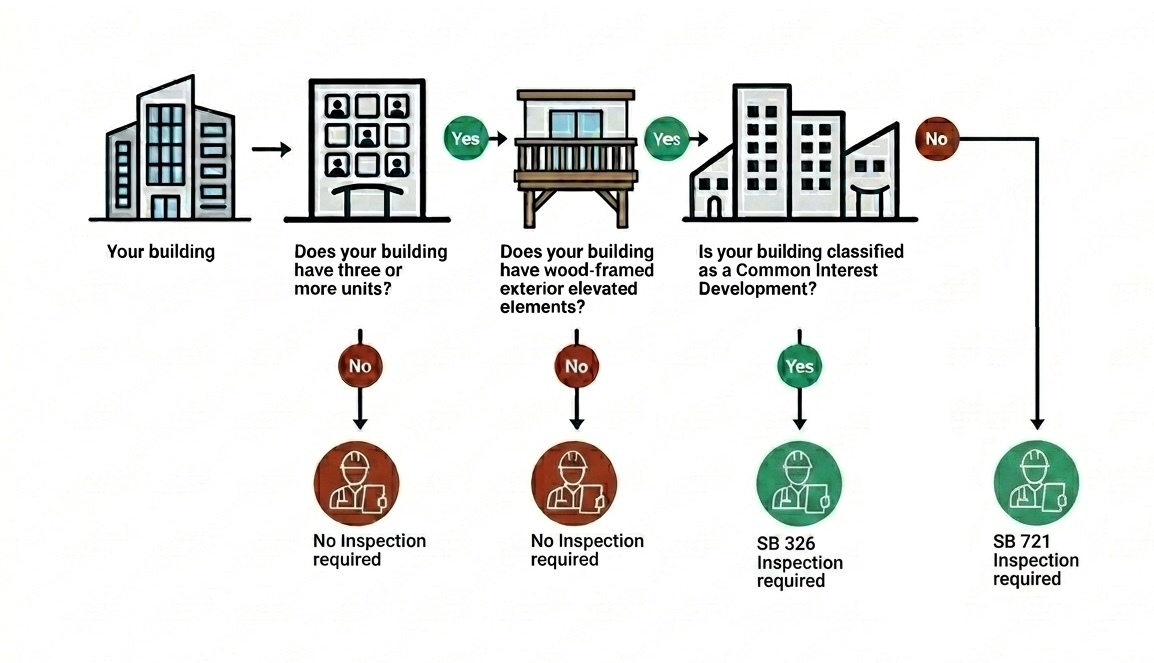
Compliance with SB-721 and SB-326 Balcony Regulations
Why Was SB721 Created?
California enacted Senate Bill 721 (SB721) and Senate Bill 326 (SB326) following a tragic balcony collapse in an apartment complex in Berkeley in 2015. The accident claimed the lives of six college students and seriously injured seven others. Investigators determined that years of water intrusion had caused extensive dry rot within the balcony’s wooden structural framing. Because the deterioration was hidden inside the structure, the balcony appeared safe until it suddenly failed.
In response, California lawmakers established new inspection requirements to help identify concealed structural damage before it becomes a safety hazard. Although both laws were created to improve balcony safety, they apply to different types of properties.
California law SB-721
SB-721 requires periodic inspections of qualifying EEEs in multifamily rental properties with three or more dwelling unit.
California law SB-326
SB-26 requires periodic inspections of qualifying EEEs in condominium associations and other common interest developments.
The purpose of both laws is to detect structural deterioration, moisture damage, wood decay, and other potentially dangerous conditions before they lead to catastrophic failures. Regular inspections help property owners identify necessary repairs early, protect residents, preserve property values, and maintain compliance with California’s balcony safety regulations. Whether your property falls under SB-721 or SB-326, scheduling a professional inspection of your balcony is an important step toward ensuring your EEEs remain safe and structurally sound.
Book Your Balcony Inspection in Pasadena Today
Avoid fines and potential serious safety issues by having your balcony inspected by a licensed general contractor or structural engineer. Call us today!
Routine Balcony Repair in Pasadena Helps:
-
Prevent costly structural reconstruction
-
Extend balcony lifespan
-
Reduce safety risks for occupants
-
Maintain compliance with inspection laws
-
Protect property value
-
Minimize long-term maintenance costs
For property owners, proactive maintenance is far more cost-effective than emergency structural repair after failure.
Our Process for Balcony Inspection and Repair
Work is conducted by Hillside General Construction & Electrical, the parent company of Pro Electrician Pasadena
Inspection
- Examine all EEEs for visible signs of deterioration or damage.
- Assess the condition of structural load-bearing components for evidence of decay, movement, or other potential safety concerns.
- Evaluate waterproofing systems for signs of moisture intrusion that could compromise the structure.
- Identify both urgent safety issues and recommended repairs needed to restore the integrity of the balcony.
Report
- Documentation prepared by the qualified inspection professional in accordance with applicable California requirements.
- Identifies the EEEs inspected
- Thorough analysis of the current condition of the structural and waterproofing components.
- Statistically significant sample of EEEs, as required by law.
- Repair recommendations, maintenance priorities, and an assessment of the remaining service life of affected components.
- Guidance to help ensure recommended repairs comply with applicable building codes and local permitting requirements.
Repairs
- Repair cracks, surface deterioration, and other damage affecting concrete, wood, or composite balcony components.
- Strengthen or replace deteriorated structural components, including beams, posts, and other load-bearing elements.
- Restore waterproofing systems by repairing or installing new membranes, sealants, and protective coatings to help prevent moisture intrusion.
- Remove corrosion and restore damaged metal elements, including railings, connectors, brackets, and structural hardware.
Comply with SB-721 and SB-326 and Avoid Fines
Get your balcony inspected by a licensed general contractor or structural engineer. Call us today!
Signs That Your Balcony Needs Repair
Not all balcony damage is immediately visible. However, there are several warning signs that indicate a professional evaluation is needed.
Soft or Spongy Walking Surface
If the surface feels soft or uneven, it may indicate hidden moisture damage or weakened framing beneath the decking.
Cracked or Peeling Waterproof Coatings
Waterproofing systems are designed to protect the structure. When they crack, bubble, or peel, water can enter and begin damaging internal components.
Wood Rot or Decay
Rotting wood may appear discolored, soft, or crumbling. This is a common sign of long-term water exposure.
Rusted Hardware and Corrosion
Metal fasteners and connectors can corrode when exposed to moisture, reducing their structural effectiveness.
Loose Railings
Railings that move or feel unstable may indicate deterioration of supporting structural elements.
Water Stains or Leaks
Stains on ceilings or walls below balconies often indicate waterproofing failure.
Concrete Cracks
Cracks in concrete surfaces can allow water penetration, eventually reaching reinforcement steel and causing further damage.
Sagging or Uneven Structure
A visibly uneven or sagging balcony is a serious warning sign requiring immediate balcony inspection in Pasadena.
If any of these issues are present, scheduling an inspection early can significantly reduce repair costs and prevent further deterioration.

Why Choose Us for Balcony Inspection in Pasadena?
About Us
✔ Licensed and insured
✔ Highly skilled and experienced in balcony inspections and repair per the law requirements
✔ Inspections conducted by a licensed general contractor or a structural engineer
✔ Detailed report with the findings, life expectancy of the balcony, and recommendations to meet the California law SB-721 and SB-326
✔ Serving Pasadena, Alhambra, Arcadia and nearby cities
✔ Reliable and friendly services
✔ Honesty and workmanship
✔ Transparent prices
✔ Great communication
FAQs
Why Balcony Repair in Pasadena Is More Important Than Ever?
Many balconies in Pasadena were built decades ago and are now reaching the stage where waterproofing systems and structural components begin to fail. Even when a balcony looks stable from the outside, hidden damage may already be developing beneath the surface. Moisture intrusion is one of the most common causes of long-term deterioration. Once water penetrates protective layers, it can lead to dry rot, mold growth, rusted fasteners, and weakening of structural framing.
In Pasadena’s climate, repeated sun exposure followed by seasonal rain creates expansion and contraction cycles that accelerate wear on waterproofing systems. Over time, small maintenance issues can turn into major structural repairs if left unaddressed.
What Cities Do We Cover for Balcony Inspection?
- Pasadena
- Glendale
- Altadena
- Arcadia
- La Crescenta-Montrose
- Eagle Rock
- Burbank
- La Cañada Flintridge
- Highland Park
- Alhambra
- San Marino
- Monrovia
- Sierra Madre
What are Load-Bearing Components?
Load-bearing components refer to wood or wood-framed structural elements that extend outside a building and support areas intended for people to walk or gather. Located more than six feet above ground level, these exterior elevated elements include balconies, decks, stairways, landings, walkways, and their supporting framing and connections.
What is a Statistically Significant Sample?
A statistically significant sample refers to inspecting a sufficient number of EEEs so the results can be confidently applied to the entire group. California’s inspection requirements generally call for a sample size that provides a 95% confidence level with a margin of error of ±5%.
What are Waterproofing Elements?
Associated waterproofing elements include flashings, membranes, coatings, and sealants, which protect the load-bearing components of exterior elevated elements from water exposure and environmental damage.
Waterproofing systems consist of components such as coating, sealants, flashings, and membranes. These are designed to shield the structural elements of balconies from moisture infiltration and environmental exposure, helping preserve their strength and long-term durability.
What are Load-bearing components?
For the purpose of complying with the California law, load-bearing components are defined as wood-based materials that project beyond a building’s exterior wall and provide a walking surface intended for human use, positioned at least six feet above ground level. This category includes balconies, decks, stairways, landings, walkways, and their associated structural supports.